


Page 30 - Our Plums - Les Pruniers de chez nous.pdf
P. 30
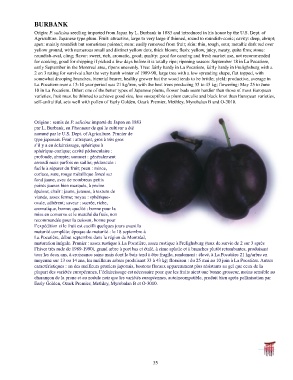
BURBANK

Origin: P. salicina seedling imported from Japan by L. Burbank in 1883 and introduced in his honor by the U.S. Dept. of
Agriculture. Japanese type plum. Fruit: attractive, large to very large if thinned, round to roundish-conic; cavity: deep, abrupt;
apex: mainly roundish but sometimes pointed; stem: easily removed from fruit; skin: thin, tough, sour, metallic dark red over
yellow ground, with numerous small and distinct yellow dots, thick bloom; flesh: yellow, juicy, meaty, quite firm; stone:
roundish-oval, cling; flavor: sweet, rich, aromatic, good; quality: good for canning and fresh market use, not recommended
for cooking, good for shipping if picked a few days before it is totally ripe; ripening season: September 18 in La Pocatiere,
early September in the Montreal area, ripens unevenly. Tree: fairly hardy in La Pocatiere, fairly hardy in Frelighsburg with a
2 on 3 rating for survival after the very harsh winter of 1989-90, large tree with a low spreading shape, flat topped, with
somewhat drooping branches, biennial bearer, healthy grower but the wood tends to be brittle; yield: productive, average in
La Pocatiere over a 13-14 year period was 21 kg/tree, with the best trees producing 33 to 43 kg; flowering: May 25 to June
10 in La Pocatiere. Other: one of the better types of Japanese plums, flower buds seem hardier than those of most European
varieties, fruit must be thinned to achieve good size, less susceptible to plum curculio and black knot than European varieties,
self-unfruitful, sets well with pollen of Early Golden, Ozark Premier, Methley, Myrobalan B and O-3010.

Origine : semis de P. salicina importé du Japon en 1883
par L. Burbank, en l’honneur de qui le cultivar a été
nommé par le U.S. Dept. of Agriculture. Prunier de
type japonais. Fruit : attrayant, gros à très gros
s’il y a eu éclaircissage, sphérique à
sphérique-conique; cavité pédonculaire :
profonde, abrupte; sommet : généralement
arrondi mais parfois en saillie; pédoncule :
facile à séparer du fruit; peau : mince,
coriace, sure, rouge métallique foncé sur
fond jaune, avec de nombreux petits
points jaunes bien marqués, à pruine
épaisse; chair : jaune, juteuse, à texture de
viande, assez ferme; noyau : sphérique-
ovale, adhérent; saveur : sucrée, riche,
aromatique, bonne; qualité : bonne pour la
mise en conserve et le marché du frais, non
recommandée pour la cuisson, bonne pour
l’expédition si le fruit est cueilli quelques jours avant la
maturité complète; époque de maturité : le 18 septembre à
La Pocatière, début septembre dans la région de Montréal,
maturation inégale. Prunier : assez rustique à La Pocatière, assez rustique à Frelighsburg (taux de survie de 2 sur 3 après
l’hiver très rude de 1989-1990), grand arbre à port bas et étalé, à cime aplatie et à branches plutôt retombantes, produisant
tous les deux ans, à croissance saine mais dont le bois tend à être fragile; rendement : élevé, à La Pocatière 21 kg/arbre en
moyenne sur 13 ou 14 ans, les meilleurs arbres produisant 33 à 43 kg; floraison : du 25 mai au 10 juin à La Pocatière. Autres
caractéristiques : un des meilleurs pruniers japonais, boutons floraux apparemment plus résistants au gel que ceux de la
plupart des variétés européennes, l’éclaircissage est nécessaire pour que les fruits aient une bonne grosseur, moins sensible au
charançon de la prune et au nodule noir que les variétés européennes, autoincompatible, produit bien après pollinisation par
Early Golden, Ozark Premier, Methley, Myrobalan B et O-3010.

                                                                           35

