


Page 55 - Our Plums - Les Pruniers de chez nous.pdf
P. 55
KAHINTA

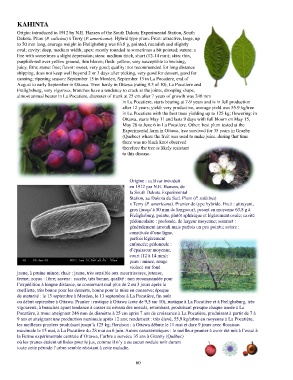
Origin: introduced in 1912 by N.E. Hansen of the South Dakota Experimental Station, South
Dakota. Plum (P. salicina) x Terry (P. americana). Hybrid type plum. Fruit: attractive, large, up
to 50 mm long, average weight in Frelighsburg was 63.8 g, pointed, roundish and slightly
oval; cavity: deep, medium width; apex: mostly rounded to sometimes a bit pointed; suture: a
line with sometimes a slight depression; stem: medium thick, short (12-14 mm); skin: thin,
purplish-red over yellow ground, thin bloom; flesh: yellow, very susceptible to bruising,
juicy, firm; stone: free; flavor: sweet, very good; quality: not recommended for long distance
shipping, does not keep well beyond 2 or 3 days after picking, very good for dessert, good for
canning; ripening season: September 15 in Morden, September 13 in La Pocatiere, end of
August to early September in Ottawa. Tree: hardy in Ottawa (rating 9.5 of 10), La Pocatiere and
Frelighsburg, very vigorous, branches have a tendency to crack at the joints, drooping shape,
almost annual bearer in La Pocatiere, diameter of trunk at 25 cm after 7 years of growth was 246 mm

                                                                  in La Pocatiere, starts bearing at 7-9 years and is in full production
                                                                  after 12 years; yield: very productive, average yield was 55.9 kg/tree
                                                                  in La Pocatiere with the best trees yielding up to 125 kg; flowering: in
                                                                  Ottawa, starts May 11 and lasts 9 days with full bloom on May 15,
                                                                  May 28 to June 6 in La Pocatiere. Other: best plum tested at the
                                                                  Experimental farm in Ottawa, tree survived for 35 years in Granby
                                                                  (Quebec) where the fruit was used to make juice, during that time
                                                                  there was no black knot observed
                                                                  therefore the tree is likely resistant
                                                                  to this disease.

                                                                       Origine : cultivar introduit
                                                                       en 1912 par N.E. Hansen, de
                                                                       la South Dakota Experimental
                                                                       Station, au Dakota du Sud. Plum (P. salicina)
                                                                       x Terry (P. americana). Prunier de type hybride. Fruit : attrayant,
                                                                       gros (jusqu’à 50 mm de longueur), pesant en moyenne 63,8 g à
                                                                       Frelighsburg, pointu, plutôt sphérique et légèrement ovale; cavité
                                                                       pédonculaire : profonde, de largeur moyenne; sommet :
                                                                       généralement arrondi mais parfois un peu pointu; suture :
                                                                       constituée d’une ligne,
                                                                       parfois légèrement
                                                                       enfoncée; pédoncule :
                                                                       d’épaisseur moyenne,
                                                                       court (12 à 14 mm);
                                                                       peau : mince, rouge
                                                                       violacé sur fond
jaune, à pruine mince; chair : jaune, très sensible aux meurtrissures, juteuse,
ferme; noyau : libre; saveur : sucrée, très bonne; qualité : non recommandée pour
l’expédition à longue distance, se conservant mal plus de 2 ou 3 jours après la
cueillette, très bonne pour les desserts, bonne pour la mise en conserve; époque
de maturité : le 15 septembre à Morden, le 13 septembre à La Pocatière, fin août
ou début septembre à Ottawa. Prunier : rustique à Ottawa (cote de 9,5 sur 10), rustique à La Pocatière et à Frelighsburg, très
vigoureux, à branches ayant tendance à casser au niveau des noeuds, retombant, produisant presque chaque année à La
Pocatière, à tronc atteignant 246 mm de diamètre à 25 cm après 7 ans de croissance à La Pocatière, produisant à partir de 7 à
9 ans et atteignant une production maximale après 12 ans; rendement : très élevé, 55,9 kg/arbre en moyenne à La Pocatière,
les meilleurs pruniers produisant jusqu’à 125 kg; floraison : à Ottawa débute le 11 mai et dure 9 jours avec floraison
maximale le 15 mai, à La Pocatière du 28 mai au 6 juin. Autres caractéristiques : le meilleur prunier à avoir été mis à l’essai à
la Ferme expérimentale centrale d’Ottawa, l’arbre a survécu 35 ans à Granby (Québec)
où les prunes étaient utilisées pour le jus, comme il n’y a eu aucun nodule noir durant
toute cette période l’arbre semble résistant à cette maladie.

                                                                           60

