


Page 89 - Our Plums - Les Pruniers de chez nous.pdf
P. 89
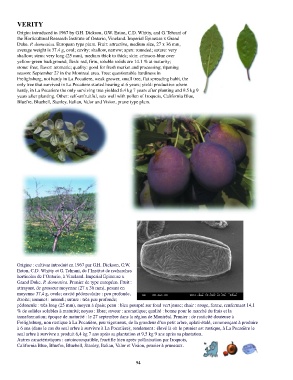
VERITY

Origin: introduced in 1967 by G.H. Dickson, G.W. Eaton, C.D. Whitty, and G. Tehrani of
the Horticultural Research Institute of Ontario, Vineland. Imperial Epineuse x Grand
Duke. P. domestica. European type plum. Fruit: attractive, medium size, 27 x 36 mm,
average weight is 37.4 g, oval; cavity: shallow, narrow; apex: rounded; suture: very
shallow; stem: very long (25 mm), medium thick to thick; skin: crimson-blue over
yellow-green background; flesh: red, firm, soluble solids are 14.1 % at maturity;
stone: free; flavor: aromatic; quality: good for fresh market and processing; ripening
season: September 27 in the Montreal area. Tree: questionable hardiness in
Frelighsburg, not hardy in La Pocatiere, weak grower, small tree, flat spreading habit, the
only tree that survived in La Pocatiere started bearing at 6 years; yield: productive where
hardy, in La Pocatiere the only surviving tree yielded 6.4 kg 7 years after planting and 9.5 kg 9
years after planting. Other: self-unfruitful, sets well with pollen of Iroquois, California Blue,
Bluefre, Bluebell, Stanley, Italian, Valor and Vision, prune type plum.

Origine : cultivar introduit en 1967 par G.H. Dickson, G.W.
Eaton, C.D. Whitty et G. Tehrani, de l’Institut de recherches
horticoles de l’Ontario, à Vineland. Imperial Epineuse x
Grand Duke. P. domestica. Prunier de type européen. Fruit :
attrayant, de grosseur moyenne (27 x 36 mm), pesant en
moyenne 37,4 g, ovale; cavité pédonculaire : peu profonde,
étroite; sommet : arrondi; suture : très peu profonde;
pédoncule : très long (25 mm), moyen à épais; peau : bleu pourpré sur fond vert jaune; chair : rouge, ferme, renfermant 14,1
% de solides solubles à maturité; noyau : libre; saveur : aromatique; qualité : bonne pour le marché du frais et la
transformation; époque de maturité : le 27 septembre dans la région de Montréal. Prunier : de rusticité douteuse à
Frelighsburg, non rustique à La Pocatière, peu vigoureux, de la grandeur d’un petit arbre, aplati-étalé, commençant à produire
à 6 ans (dans le cas du seul arbre à survivre à La Pocatière); rendement : élevé là où le prunier est rustique, à La Pocatière le
seul arbre à survivre a produit 6,4 kg 7 ans après sa plantation et 9,5 kg 9 ans après sa plantation.
Autres caractéristiques : autoincompatible, fructifie bien après pollinisation par Iroquois,
California Blue, Bluefre, Bluebell, Stanley, Italian, Valor et Vision, prunier à pruneaux.

                                                                           94

