


Page 82 - Our Plums - Les Pruniers de chez nous.pdf
P. 82
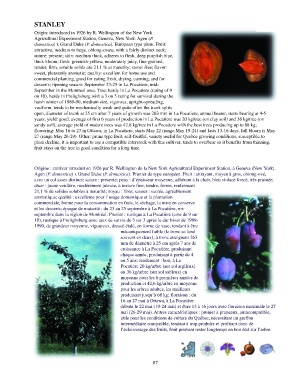
STANLEY

Origin: introduced in 1926 by R. Wellington of the New York
Agricultural Experiment Station, Geneva, New York. Agen (P.
domestica) x Grand Duke (P. domestica). European type plum. Fruit:
attractive, medium to large, oblong-ovate, with a fairly distinct neck;
suture: present; skin: medium thick, adheres to flesh, deep purplish blue,
thick bloom; flesh: greenish-yellow, moderately juicy, fine-grained,
tender, firm, soluble solids are 21.1 % at maturity; stone: free; flavor:
sweet, pleasantly aromatic; quality: excellent for home use and
commercial planting, good for eating fresh, drying, canning, and for
desserts; ripening season: September 23-25 in La Pocatiere, mid-
September in the Montreal area. Tree: hardy in La Pocatiere (rating of 9
on 10), hardy in Frelighsburg with a 3 on 3 rating for survival during the
harsh winter of 1989-90, medium size, vigorous, upright-spreading,
vasiform, tends to be mechanically weak and quite often the trunk splits
open, diameter of trunk at 25 cm after 7 years of growth was 263 mm in La Pocatiere, annual bearer, starts bearing at 4-5
years; yield: good, average of first 6 years of production in La Pocatiere was 20 kg/tree (on clay soil) and 36 kg/tree (on
sandy soil), average yield of mature trees was 42.6 kg/tree in La Pocatiere with the best trees producing up to 68 kg;
flowering: May 16 to 27 in Ottawa, in La Pocatiere, starts May 22 (range May 19-24) and lasts 13-16 days, full bloom is May
27 (range May 26-29). Other: prune type fruit, self-fruitful, variety useful for Quebec growing conditions, susceptible to
plum decline, it is important to use a compatible interstock with this cultivar, tends to overbear so it benefits from thinning,
fruit stays on the tree in good condition for a long time.

Origine : cultivar introduit en 1926 par R. Wellington de la New York Agricultural Experiment Station, à Geneva (New York).
Agen (P. domestica) x Grand Duke (P. domestica). Prunier de type européen. Fruit : attrayant, moyen à gros, oblong-ové,
avec un col assez distinct; suture : présente; peau : d’épaisseur moyenne, adhérant à la chair, bleu violacé foncé, très pruinée;
chair : jaune verdâtre, modérément juteuse, à texture fine, tendre, ferme, renfermant
21,1 % de solides solubles à maturité; noyau : libre; saveur : sucrée, agréablement
aromatique; qualité : excellente pour l’usage domestique et la plantation
commerciale, bonne pour la consommation en frais, le séchage, la mise en conserve
et les desserts; époque de maturité : du 23 au 25 septembre à La Pocatière, mi-
septembre dans la région de Montréal. Prunier : rustique à La Pocatière (cote de 9 sur
10), rustique à Frelighsburg avec taux de survie de 3 sur 3 après le dur hiver de 1989-
1990, de grandeur moyenne, vigoureux, dressé-étalé, en forme de vase, tendant à être

                                                      mécaniquement faible (le tronc se fend
                                                      souvent en deux), à tronc atteignant 263
                                                      mm de diamètre à 25 cm après 7 ans de
                                                      croissance à La Pocatière, produisant
                                                      chaque année, produisant à partir de 4
                                                      ou 5 ans; rendement : bon, à La
                                                      Pocatière 20 kg/arbre (sur sol argileux)
                                                      ou 36 kg/arbre (sur sol sableux) en
                                                      moyenne pour les 6 premières années de
                                                      production et 42,6 kg/arbre en moyenne
                                                      pour les arbres adultes, les meilleurs
                                                      produisant jusqu’à 68 kg; floraison : du
                                                      16 au 27 mai à Ottawa, à La Pocatière
                                                      débute le 22 mai (19-24 mai) et dure 13 à 16 jours avec floraison maximale le 27
                                                      mai (26-29 mai). Autres caractéristiques : prunier à pruneaux, autocompatible,
                                                      utile pour les conditions de culture du Québec, nécessitant un greffon
                                                      intermédiaire compatible, tendant à trop produire et profitant donc de
                                                      l’éclaircissage des fruits, fruit pouvant rester longtemps en bon état sur l’arbre.

                                                                           87

